
|
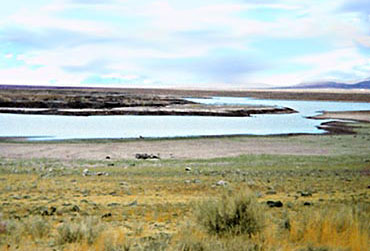
Cow Lakes - Upper Cow Lake &
Lower Cow Lake is located in
Harney County in Southeast Oregon, approximately 15
miles west-northwest of Jordon Valley. These are flat, playa lakes, that were
formed when the Jordon Craters lava flow blocked stream
flows. The area contains large areas of open water and
emergent vegetation. Exposed mudflats are present in
late summer. Large numbers of moist soil dependent
plants are present. This cluster of lakes and marshes
regularly has several thousand waterfowl and over 100
shorebirds in season (Marty St. Louis pers. comm.). In
addition, several dozen pairs of Black-crowned
Night-Herons breed in dense marshes in the Batch L.
complex near Cow Lakes (Contreras and Kindschy 1996).
The Cow Lakes area is also considered important as a
Shrub-Steppe Bird Conservation Area (Altman and Holmes
2000).
Conservation Issues Enforcement of existing land use
policies on BLM land may be inadequate: too many cattle
too long, ORV use is high. Exotic plants are common at
this site.

Contacts Bureau of Land Management
Vale District Office
100 Oregon Street
Vale, OR 97918
The geological background of this province is based in
volcanic activity which started in the Miocene. There
are deep volcanic deposits of basalts, tuffs and
tuffaceous sediments. While basalt is prevalent, other
features include rhyolite, diatomaceous deposits, new
sedimentary deposits and new surface lava. The episodes
of deposition affecting the Owyhee uplands include the
Owyhee Basalts that erupted onto the plateau 13-12
million years ago and the ash-flow tufts from the Steens
mountains around the same time. In a few areas there has
been relatively recent volcanism, of special note is
Jordan Craters.
The Jordan Craters lava flow is located in the Owyhee
uplands on the plateau. It is a 75 square kilometer
olivine basalt flow that is extremely recent by
geological time. Potassium argon (K-Ar) dating shows
that it is no older than 30,000 years. However, "studies
based on growth rates of lichen and weathering rates of
exposed and unexposed basalt suggest that the flow may
be between 4,000 and 9,000 years old". "Additionally the
southeasterly flowing lava altered ancestral drainage
patterns, giving rise to a natural dam and the formation
of two small lakes (Upper and Lower Cow Lakes)"
|