Pronghorns often graze
the slopes to the west and north of the lake,
and coyotes get so noisy at times as to disrupt
one's sleep. Other wildlife common in the area
includes jackrabbits, bobcats, burrowing owls,
sage grouse, chukar partridge, valley quail, and myriad raptors, waterfowl
and reptiles.
Mann Lake rewards visitors with 10- and
20-fish days, especially during periods of stable weather, and
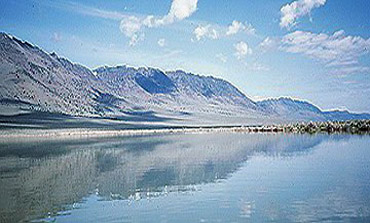
remarkable scenery. The lake provides scenic views of the
looming, 9,000-plus-foot Steens Mountains, a huge fault-block
range rising gently from the west but dropping thousands of
near-vertical feet on its east face. The steep slope dominates
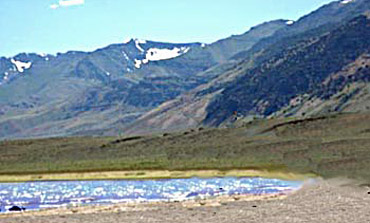
the skyline above Mann Lake. Between March and May - the most
popular time for fishing here - broad sheets of snow gleam ivory
white on the Steens, and storm clouds frequently gather over the
rugged crags.
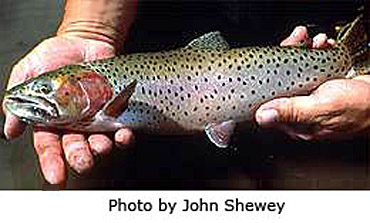
Mann Lake is home to an abundance of
Lahontan Cutthroat trout, sub-specie of cutthroat that is the
only salmonid that can survive in Mann, which is among the most
alkaline of Oregon lakes. As such Mann Lake is the Oregon State
repository for the Lahontan Cutthroat, and where all of the
states brood stock are raised.
Oregon Department of
Fish and Wildlife stocks the 200-acre Mann Lake with Lahontan
cutthroat trout. Native to Nevada's Lahontan Basin and perfectly
adapted to high-alkaline Great Basin waters, these beautiful
fish grow rapidly in Mann's shallow, fertile broth. Within three
seasons here cutts span 18 to 22 inches, which is a major reason
Mann ranks as a favorite destination of Oregon fly anglers.
To Get There:Mann Lake hunkers behind the Steens
Mountains a long way from everything. The drive from Burns
covers nearly 100 miles, a quarter of that on gravel. Follow
U.S. Highway 20 to Burns, and follow Highway 78 south,
eventually passing the tiny towns of Crane and New Princeton.
The road climbs the relatively gentle northern extension of the
Steens Mountains and then winds down the backside of the range,
where a right turn awaits at Fields-Denio Road (gravel), which
leads some 25 miles to Mann Lake. Along the way you will pass
the Juniper Lakes, but don't mistake these for Mann. Watch for
the signed right turn into the lake. The access road wraps
around the lake's north shore. Boat ramps are located on each
side of the lake.
A longer route to Mann Lake follows
State Route 205 from Burns through the Malheur Wildlife Refuge
and Frenchglen. Continue south on Highway 205, which leads
through Catlow Valley and eventually crosses the foothills and
meets Fields-Denio Road north of Fields. Turn left; Mann Lake
lies another hour or so north.
Ample unimproved camping
space waits at Mann. This is bring-your-own country, including
water, firewood and shelter. If you prefer cozier lodgings,
there's a tiny motel in Fields, 541-495-2275. A quaint diner
there serves excellent milkshakes and burgers, and an adjacent
store has basic supplies and gasoline.
Mann Lake was
named for an early nearby rancher, Philip Mann. The closest town
is Fields. Charles Fields homesteaded on the present town site
and established a station in 1881 that supplied the needs of
people traveling through the area. The Fields post office was
established in 1913. Fields has a gas station, general store,
cafe and motel and is the largest community on the east side of
Steens Mountain. It is 21 miles to Denio located on the border
of Oregon and Nevada. The cafe at Fields is reported to have a
cheeseburger and shake worth driving from Frenchglen.
For More Info Call Oregon Department of Fish & Wildlife at
541-573-6582 or the Harney County Chamber 541-573-2636
Add More Information!
We Can Add More Information to
this page,
Click Here and supply
your text info and we will add it in!
BACK TO LAKES PAGE This
is a general information page. All lake information on is
provided to users on an "as is" and "as available" basis without
warranty of any kind either express or implied.
SouthernOregon.com is not responsible for any change in lake
information, conditions, amenities, misprint, hours or
directions. See
terms page to read more user details.